
Rostec Started Commercial Production of Neural Network Equipment with Innovative Cooling System
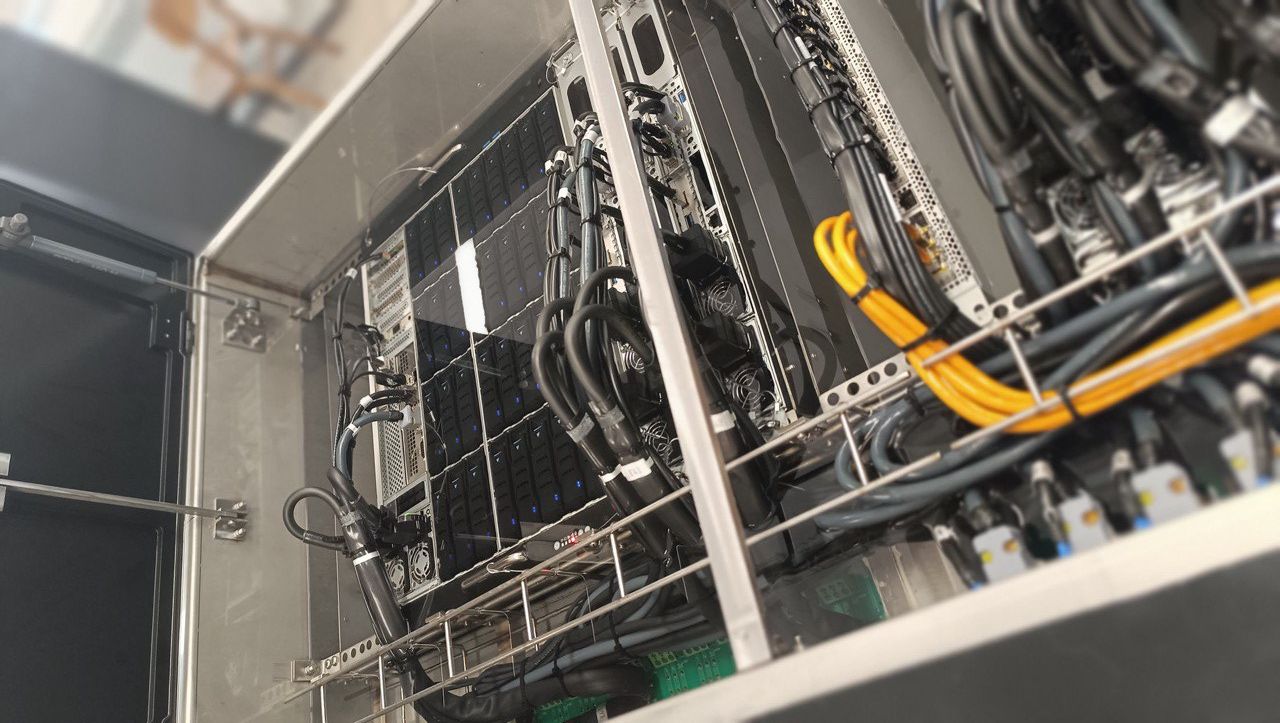
The product will reduce energy consumption, heating and sizes of data centers, and will replace imported solutions
Photo: Rosel
Rosel holding has mastered a liquid-cooled high-performance computing system technology and commercial production to provide neural network operation and learning. The solution includes the assembly and installation of dedicated equipment with original architecture. Rosel’s product will reduce data center energy consumption, heating and sizes, and will replace imported solutions.
Liquid cooling implies equipment immersion into dielectric — a special substance that removes heat, but doesn’t affect electronics operation. Because the dielectric fills the entire computing system space, IT components may be packed more closely. It will be possible to create compact data centers for neural networks, whose footprint is 3 to 5 times smaller than that of the existing ones.
Modern dielectric liquids are nontoxic, inflammable and biodegradable, i.e. more environment-friendly compared with traditional freon. Rosel’s cooling system uses proprietary dielectric that has all required specifications.
“Liquid cooling is not merely an innovation, but also an important strategic technology. It will reinforce global standing of Russia in the development of artificial intelligence and high-performance computing, simultaneously reducing the industry’s carbon footprint. Russia is among a few countries that develop this technology. Only the USA and China can adequately compete in this area. Development of domestic technologies allows us to avoid foreign solutions,” said Rosel’s representatives.
Quiet operation and durability are among the key properties of the liquid cooling technology. A sealed medium protects the equipment against dust, corrosion and temperature drop. In addition, the solution will be used to overclock CPU’s, including GPU’s, without automatic reduction of the clock rate to prevent overheating and damage. This will facilitate artificial intelligence development and streamline neural network learning.
The liquid cooling technology is extremely in demand because traditional air systems are not keeping up any longer with powerful CPU’s and video cards that are used for neural networks and supercomputers. However, solutions based on liquid cooling consume 30% to 50% less energy than the best air-cooling counterparts.